AutomationJuly 5, 20264 min read
Building a Real-Time Project Resourcing Engine: Syncing Jira, Slack, and Airtable with n8n
Stop manual tracking and start scaling: How to build a unified resource management engine using n8n.
 Scope My Build
Stop manual tracking and start scaling: How to build a unified resource management engine using n8n.
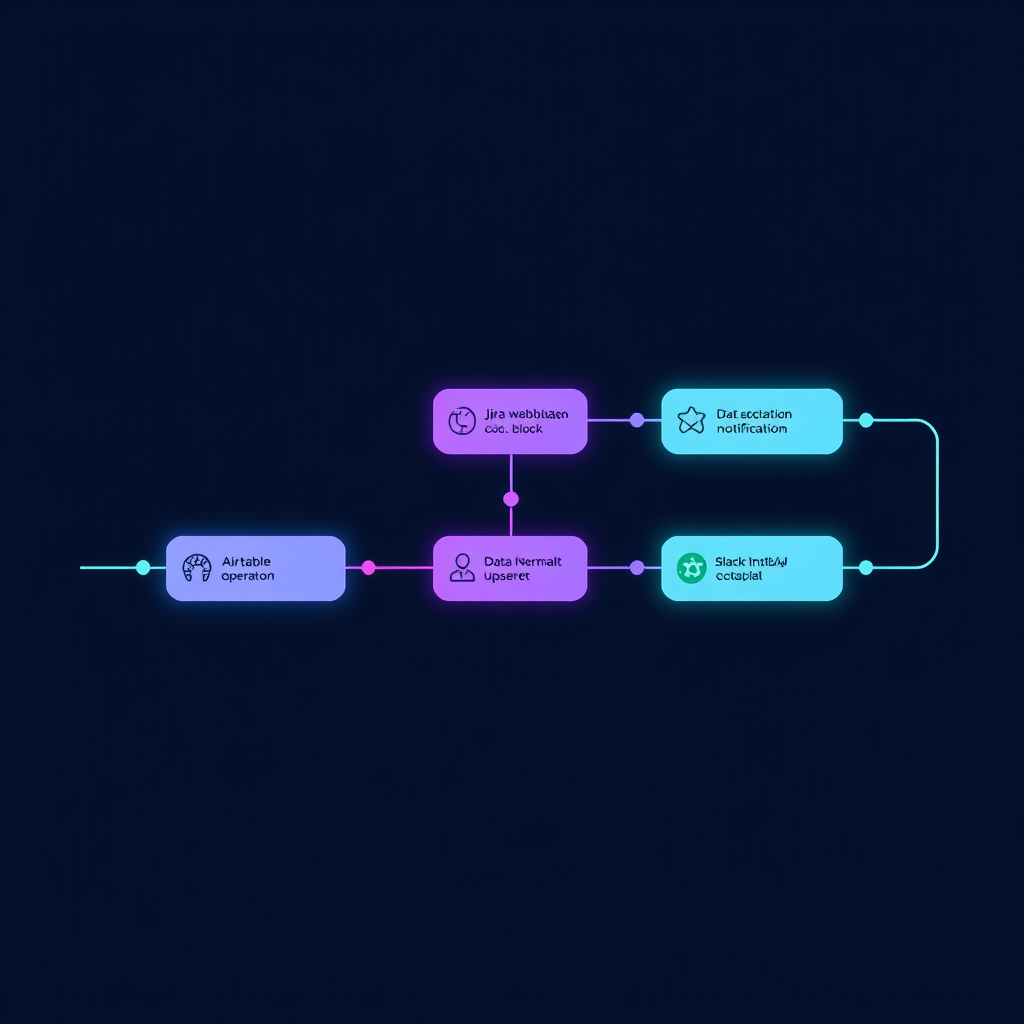
issue_updated or issue_created. We filter these events to focus on status changes or assignee updates. \n\n### 2. Data Normalization with n8n\nOnce the data hits n8n, we don't just pass it through. We use the Code node to normalize the payload. We map Jira's complex JSON structure into a clean, flat object that Airtable understands. This is critical for maintaining data integrity when automating project resource management with n8n Jira and Airtable integration.\n\n### 3. The Airtable Upsert\nWe use the Airtable API to perform an 'upsert' operation. We look for a record matching the Jira Issue Key. If it exists, we update the status and hours; if not, we create a new entry. This ensures your Airtable base is always a mirror of your Jira board.\n\n### 4. Slack Notification Loop\nFinally, we push a summary to a dedicated Slack channel. Using the Slack node, we format a message that includes the project name, the assignee, and the estimated hours. This keeps the team informed without requiring them to leave their flow.\n\n## Case Study: Scaling Resource Visibility for a SaaS Scale-up\n\nWe recently worked with a SaaS company struggling with a 40-person engineering team. Their resource management was entirely manual, relying on a Google Sheet that was updated once a week. By the time the data was reviewed, it was already obsolete.\n\nWe implemented a custom n8n workflow that:\n- Syncs Jira ticket estimates to Airtable in real-time.\n- Calculates remaining capacity per developer based on their current Jira load.\n- Alerts the Project Manager via Slack if a developer's capacity exceeds 40 hours per week.\n\nThe Result: The client reduced their weekly manual reporting time from 8 hours to zero. More importantly, they identified a 15% under-utilization rate in their engineering team, allowing them to pull forward two major product features that were previously delayed.\n\n## Why n8n is the Superior Choice for Engineering Teams\n\nUnlike low-code platforms that hide the logic, n8n gives us full control over the execution. We can use JavaScript to handle complex logic, integrate with Automation Services & Capabilities via REST APIs, and even incorporate OpenAI or LangChain for intelligent ticket summarization.\n\nWhen you are automating project resource management with n8n Jira and Airtable integration, you need a system that is transparent and debuggable. n8n’s visual interface allows our engineers to trace every execution, ensuring that if an API call fails, we know exactly why.\n\n## Beyond the Basics: Adding AI to the Mix\n\nOnce you have the data flowing, the next step is intelligence. We have been experimenting with using LangChain within n8n to analyze Jira ticket descriptions. By passing these descriptions to an LLM, we can automatically suggest 'complexity scores' and update the Airtable record accordingly. This turns your resourcing engine from a passive tracker into an active planning assistant.\n\n## Ready to Build Your Own Engine?\n\nBuilding a custom resourcing engine is not just about connecting APIs; it is about designing a workflow that fits your team's specific cadence. If you are tired of manual data entry and want to see how we can help you scale your operations, we are here to help.\n\nCheck out our Blog for more deep dives into our technical stack, or if you are ready to see what is possible for your specific infrastructure, Book a Free Automation Audit today. Let's get your systems talking to each other.Written by the HDX Automation engineering team, specialists in workflow automation, CRM integrations, API systems, reporting pipelines, and AI operations.
Connect with our engineers to draft a custom roadmap tailored specifically for your team's workflow.